Benchmarks
Keel is scored on Terminal-Bench 4.0, Terminal-Bench 2.0, Aider Polyglot and SWE-bench Lite, with the same 10 hand-picked tasks from each every time. Keel includes an adapter for Harbor (install it with uv tool install harbor), which runs each task in its own Docker container, runs Keel inside it, and scores the result with the task's official tests.
Every change to the harness gets a score. The chart has one bar per run, grouped by benchmark, so you can watch the success rate move as Keel gains new abilities. To run the benchmarks yourself or add a run, see Running the benchmarks.
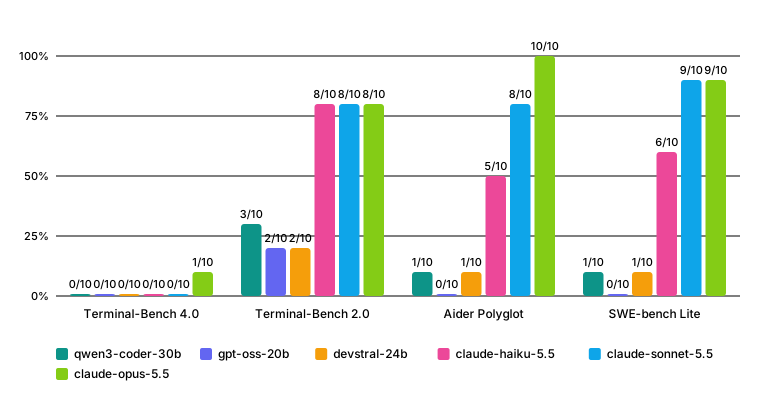
Scoreboard
| Harness | Model | Terminal-Bench 4.0 | Terminal-Bench 2.0 | Aider Polyglot | SWE-bench Lite |
|---|---|---|---|---|---|
| baseline | qwen3-coder:30b | 0/10 | 3/10 | 1/10 | 1/10 |
| baseline | gpt-oss:20b | 0/10 | 2/10 | 0/10 | 0/10 |
| baseline | devstral:24b | 0/10 | 2/10 | 1/10 | 1/10 |
| baseline | us.anthropic.claude-haiku-5-5 | 0/10 | 8/10 | 5/10 | 6/10 |
| baseline | us.anthropic.claude-sonnet-5-5 | 0/10 | 8/10 | 8/10 | 9/10 |
| baseline | us.anthropic.claude-opus-5-5 | 1/10 | 8/10 | 10/10 | 9/10 |
Each cell is tasks passed out of tasks attempted. Every run uses the same 10 hand-picked tasks per benchmark (the lists are in bench/subsets/), so a bar going up means the harness got better, not that the questions got easier.
How a run is scored
- Pass means the official tests passed. Terminal-Bench and Aider Polyglot run each task's own tests in its container. SWE-bench Lite is graded by the SWE-bench harness.
- Errors count as failures. If a task can't start or can't be graded, it scores zero, because the harness is what has to cope with it.
- Same tasks every time. The task lists are fixed, so runs are comparable. Growing a list starts a new series.
- Everything is recorded. Each run lives in
runs/<run>/with amanifest.jsonholding the commit, the hash ofagent.ts, the machine and the exact tasks, next to every trial's logs.
Models and harness changes
Every run records two separate labels in its manifest: the harness (baseline, edit-tool, and so on) and the model. That keeps the two questions apart, and a leaderboard can sort or filter by either:
| Question | Hold fixed | Change | Example |
|---|---|---|---|
| Which model is best in this harness? | Harness | Model | HARNESS=baseline, a different model |
| Which harness change helps? | Model | Harness | the same model, HARNESS=edit-tool |
The folder name combines them, runs/<model>/ for the baseline and runs/<model>-<harness>/ after that.